You may have seen “SAF” on a boarding pass or airline site and wondered what it means. What is sustainable aviation fuel? It is a drop-in jet fuel made from waste, residues or other non-fossil sources, blended with ordinary kerosene.
| Item | Value |
|---|---|
| Estimated global SAF output, 2025 | 1.9 Mt |
| SAF share of jet fuel use, 2025 | 0.6% |
| IATA projected SAF output, 2026 | 2.4 Mt |
| Blend limits across approved pathways | 10% to 50% |
| Estimated extra industry fuel cost from the SAF premium, 2025, at price levels in IATA’s December 2025 release | USD 3.6 billion |
Figures come from IATA’s December 2025 press release and the US Department of Energy’s Alternative Fuels Data Center. They can change, so check the sources before you rely on them.
What sustainable aviation fuel actually is
Sustainable aviation fuel (SAF) is, in the words of Europe’s aviation safety agency EASA, “a sustainable, non-conventional, alternative to fossil-based jet fuel.” It is chemically very close to the kerosene it replaces.
That closeness is the point. Under the EU’s ReFuelEU Aviation Regulation, drop-in fuels are the category that counts as SAF, as EASA explains on its page on sustainable aviation fuels. Drop-in means no new engines or airport pipes are needed.
The US Department of Energy says the same in its SAF overview: SAF blended with conventional Jet A “can be used in existing aircraft and infrastructure.”
How SAF is made: the main pathways
Each approved route is defined by its feedstock, conversion technology, fuel properties and maximum blending fraction. The US Department of Energy lists the main ones in the same overview.
- Fischer-Tropsch (FT-SPK): woody biomass, municipal solid waste or agricultural residues are gasified into syngas, then converted to jet fuel. It was approved in 2009 with a 50% blend limit.
- HEFA-SPK: It was approved in July 2011 with a 50% limit.
- Alcohol-to-jet (ATJ-SPK): It was approved in April 2016 for isobutanol and June 2018 for ethanol, with a 30% limit.
- HC-HEFA-SPK: algal oil is converted to jet fuel. It was approved in 2020 with a 10% limit.
For related background, read about second generation biofuels.
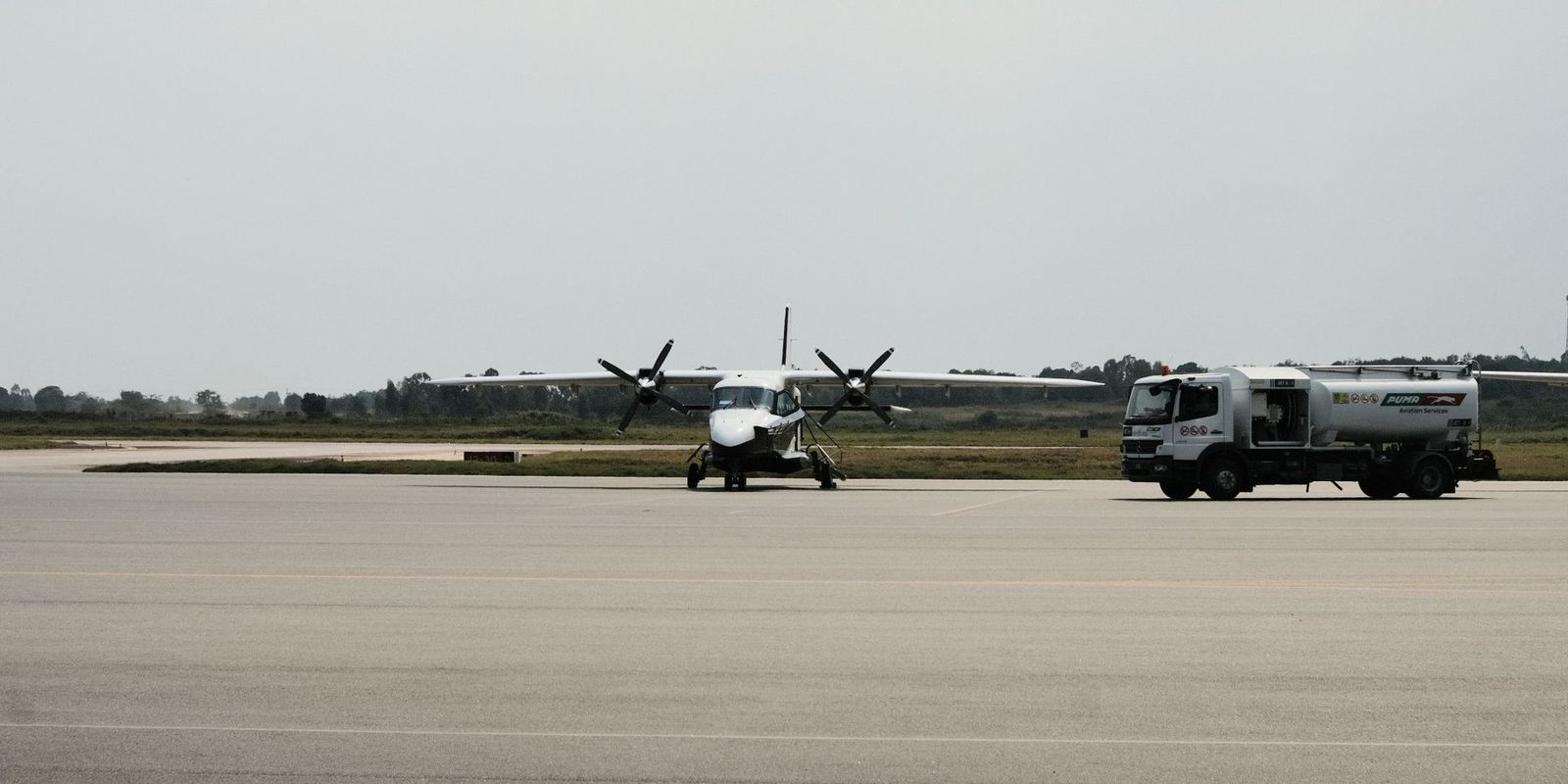
Why SAF is blended rather than used neat
Standard ASTM D7566 sets the quality rules for non-petroleum jet fuel. It lists the approved SAF types and the share each may make up in a blend with Jet A.
The Department of Energy says SAF “can be blended at different levels with limits between 10% and 50%, depending on the feedstock and how the fuel is produced.” EASA adds that once a blend meets the D7566 requirements, the fuel is redeclared and treated as ordinary Jet A or Jet A-1.
A second route is co-processing, where renewable feedstock runs through a petroleum refinery alongside crude-derived streams. The Department of Energy notes that ASTM D1655 allows co-processing of biomass feedstocks in blends up to 5%. EASA reports that standards committees are working to raise blending limits.
How much SAF is made today?
Very little compared with total jet fuel use. IATA’s December 2025 release estimates output of 1.9 Mt in 2025, which is only 0.6% of total jet fuel consumption. It projects growth to slow in 2026, reaching 2.4 Mt.
IATA says the 2025 figure was a downward revision from its earlier forecasts, citing a lack of policy support to use installed capacity fully. At the price levels in that release, it also estimates the SAF premium would add USD 3.6 billion to the industry’s fuel costs in 2025.
The US government set a target through its Sustainable Aviation Fuel Grand Challenge, announced in 2021. It aims for domestic consumption of 3 billion gallons in 2030 and 35 billion gallons in 2050, with at least a 50% reduction in lifecycle emissions.
How a new SAF route gets approved
A fuel cannot simply be declared SAF. A producer has to take a new route through the ASTM qualification process, which tests whether the fuel behaves like conventional jet fuel in engines and fuel systems.
EASA says this process is “both expensive and time-consuming for all involved stakeholders.” That has led to several SAF Clearing Houses, including the EU SAF Clearing House, which is funded by the EU and managed by EASA. It acts as a “one stop” knowledge centre for fuel producers working through the ASTM process.
The result is a slow, careful expansion of the approved list. The Department of Energy notes that processes and tests exist for approving other feedstocks, fuel molecules and blending limits, so the list of approved fuels will grow as they are evaluated.
Where the blending happens and who buys it
Blending usually does not take place at the airport. The Department of Energy says it is technically possible to blend fuels there, but it is not the most practical or cost-effective method because of the need for extra equipment, staff and insurance.
On the demand side, the Department of Energy reports that many airlines have signed agreements with existing and future SAF producers to use all their expected output. It describes production as being in its early stages, and names World Energy as one producer: it began SAF production in 2016 at its Paramount, California, facility and first supplied Los Angeles International Airport.
In practice, this means that:
- Producers make a neat SAF that meets one of the approved annexes.
- The neat fuel is blended with conventional kerosene up to the pathway’s limit.
- The blend is certified to the relevant specification and treated as ordinary jet fuel.
- Airlines buy it under supply agreements and fly it in existing aircraft.
Electrofuels and other terms you may see
Names for these fuels vary with regulation and technology. EASA notes that for synthetic aviation fuels, a variety of terminologies are used, such as liquid Renewable Fuels of Non-Biological Origin (RFNBO) in ReFuelEU Aviation, but also electrofuels, e-Fuels and Power-to-Liquid.
So SAF is an umbrella term rather than one product. Some SAF comes from biological waste and residues, and some is synthetic. Each type is defined by its feedstock and conversion route, which is why reading the pathway name tells you more than the label alone.
What “sustainable” means in practice
The word refers to lifecycle emissions, meaning the whole chain from growing or collecting the feedstock to burning the fuel. Burning SAF still releases carbon dioxide, so the saving depends on how the feedstock was sourced and processed.
Regulators also restrict feedstock. EASA notes that in the EU, aviation biofuels exclude fuels produced from food and feed crops. For background on the wider family of fuels, see what are biofuels, and for further examples read advanced biofuels examples.
Frequently asked questions
Can existing planes fly on SAF?
Show answer
Yes, within the approved blend limits. That is the reason the fuel is designed as a drop-in product.
Is SAF the same as ordinary jet fuel?
Show answer
Once a blend meets ASTM D7566 requirements, EASA says it is redeclared and treated as Jet A or Jet A-1. It is a drop-in fuel.
Why is so little SAF used?
Show answer
Supply is small. IATA estimated SAF at 0.6% of jet fuel use in 2025, and it says the SAF premium raises airline costs.
Does SAF remove all flight emissions?
Show answer
No. The US target aims for at least a 50% lifecycle emissions reduction, so savings depend on feedstock and process.